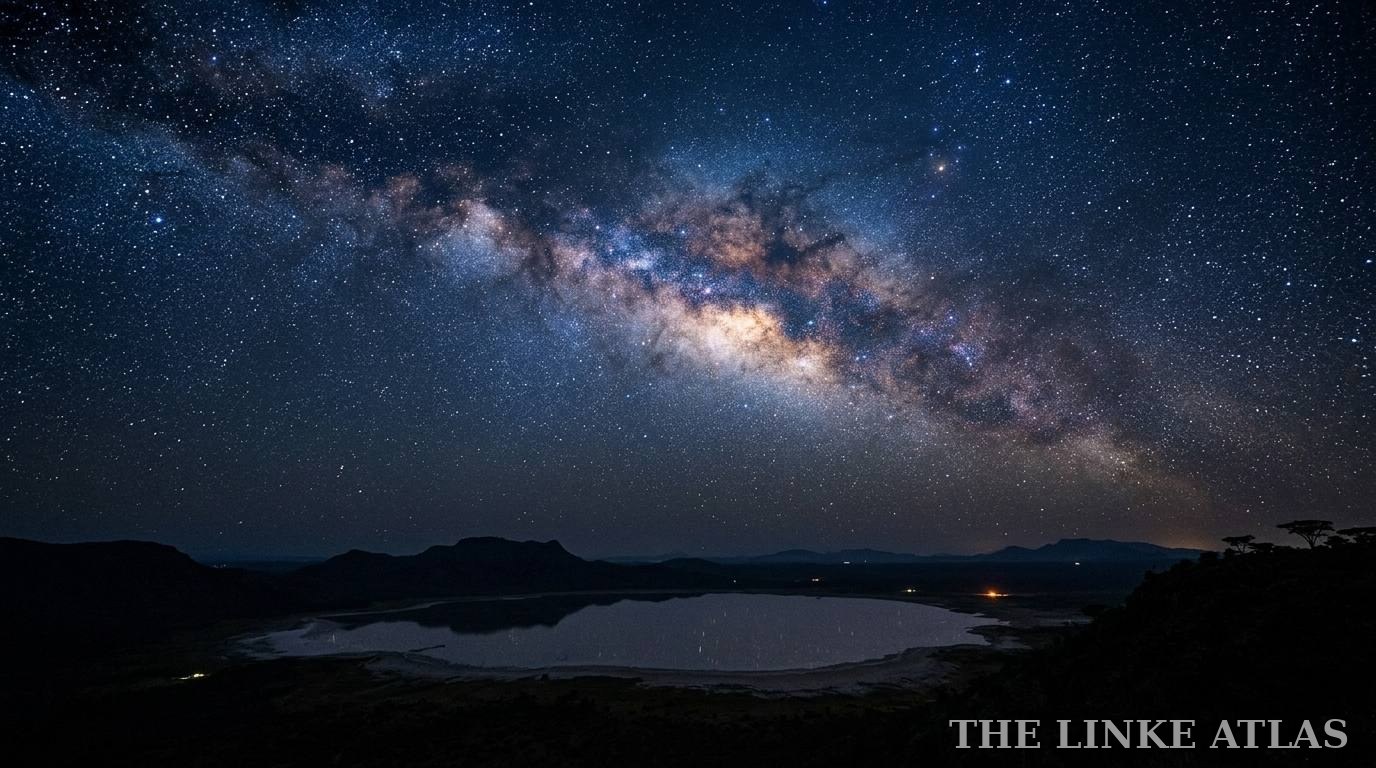
Venus as the place of origin, a ladder let down from the sky, a star worn on the forehead: the Samburu keep their story in the stars, and the sky still hums with it.
Listen. The universe is vibrating, and the Samburu have been tuning in for a very long time. Long before satellite calendars and phone alarms, the night sky was how people on the Northern Frontier kept time. In a landscape with almost no artificial light, the stars are bright, close and impossible to ignore. Herders walking at night, elders telling stories at the fire and children lying on their backs outside the homestead have all looked up at the same patterns for generations.
The oldest sky story of all is the one about where the Samburu came from. According to the Samburu creation story, recorded by the National Museums of Kenya's Paukwa project, people began their lives on Venus, the morning star. Nkai, God, let down a ladder, and the people climbed down it to a new world that had been made for them. When they reached the end they stood on Earth, and they took it up gladly as loikop, the owners of the land. The Nairobi jeweller and collector Rhodia Mann, who spent years among the Samburu, believes this tradition of Venus as the homeland is unique to them.
You can see the story worn on the body. A Samburu woman may wear a star-shaped pendant on her forehead, which points back to that origin on Venus. And before a bridal procession leaves for the groom's home, elders line up on either side to bless the couple, and the lines they form resemble the pattern of Orion. The sky is written into the wedding.
Reading the sky has also been a calling. The Samburu believe that fate is written in the stars, and that the stars carry warnings of drought, disease and danger long before they arrive. The great astrologers came from one family, the Lesepen lineage, whose founder Mpunyati Lesepen was remembered as a man who read Nkai's messages in the night sky and warned the people of what was coming. Mann found that the personal star of the Lesepen diviner she worked with was Venus in its morning-star aspect, which ties the astrologer to the same story of origin. She gathered her years of work into the book Talk to the Stars: The Samburu of Northern Kenya, with photographs by Clive Ward, launched at the Nairobi National Museum in 2000.
The sky was a working calendar as well as a story. Stars that rise before dawn, and stars that signal the turn of a season, told herders when to move, when the rains might come and how to keep their direction when the land went dark and the tracks disappeared. A ceremony could be timed by a diviner reading the sky. Sky knowledge and oral history are the same inheritance, told in two registers.
I like to think of it as frequency. Every star in the Samburu sky sends something, whether warning, welcome, season or memory, and the people who learned to listen built a language out of it. It is a language older than words, which is why this journal exists.
The sky over Samburu is still among the best in Africa. High elevation, clean air and almost no artificial light make it a natural observatory, and because Samburu sits on the equator you can see both the northern and southern skies from the same spot. Sopa Lodges and Leo Sky Africa have launched what was reported as the first certified astro-tourism package in a Kenyan hotel, at Samburu Sopa Lodge, built partly around Samburu stories and beliefs about the sky. The Kenya Space Agency's Joan Tanin has said Samburu is emerging as a serious contender among Africa's stargazing destinations, and Kenya will see a partial solar eclipse in 2027.
What lives in memory can fade within a generation if nobody asks, listens and records it. Younger people spend their evenings in school and with screens, and the elders who hold the old sky knowledge are fewer every year. That is the work behind the Star Names Project in our portfolio, and it is why a night under the Ololokwe sky is worth more with a guide who can tell the stories as well as point out the stars.
The United Nations has declared 2022–2032 the International Decade of Indigenous Languages, and the sky stories of the Samburu belong in that work, because a language carries a whole way of perceiving the universe. Agenda 2063's Aspiration 5, an Africa with a strong cultural identity and common heritage, asks for the same care. Frequency, vibration and meaning are one thing seen from three sides, and the stars have been teaching it all along.
Sources: Paukwa (National Museums of Kenya), Samburu Myth of Creation: From Venus to Earth, published 1 February 2024; Paukwa, Mpunyati Lesepen: The Great Astrologer, published 3 September 2021; The Star (Kenya), Museum displays beauty of the Samburu culture, 25 July 2024; Business Daily Africa, Kenya's darkest sky: why Samburu is a stargazer's heaven; Tourism Update, Sopa Lodges launches astro tourism experience.